17/03/2026
In the precision mechanics sector, bar and rotary table machining represent two complementary approaches, the choice of which directly affects quality, dimensional reliability and production continuity.
At Guerrini Lauro we operate on a daily basis on complex turned components, competently managing both bar machining, with and without automatic loader, and machining on semi-finished products using rotary table machines.
In this article we will see the specific characteristics of these different processes and highlight the importance of knowing how to choose and govern the most suitable process according to the piece, the tolerances required and the production batch.
This solution is suitable for:
This configuration is ideal for:
Maintaining precision throughout the production cycle requires:
This configuration allows you to perform multiple operations in a single setup:
At Guerrini Lauro we face these challenges on a daily basis thanks to:
This operational flexibility represents a concrete value for customers who are looking for suppliers capable of not only governing complex processes.
The difference is not only in the technology, but in the ability to manage it. CNC bar machining requires expertise, control, and deep knowledge of the behavior of the material in rotation.
This is where Guerrini Lauro makes the difference: transforming a technical criticality into a production strength.
Bar and rotary table machining: characteristics and strengths
In the precision mechanics sector, bar and rotary table machining represent two complementary approaches, the choice of which directly affects quality, dimensional reliability and production continuity.
At Guerrini Lauro we operate on a daily basis on complex turned components, competently managing both bar machining, with and without automatic loader, and machining on semi-finished products using rotary table machines.
In this article we will see the specific characteristics of these different processes and highlight the importance of knowing how to choose and govern the most suitable process according to the piece, the tolerances required and the production batch.
- Bar machining with and without loader
- The Complexities of Bar Machining
- Machining on semi-finished products with rotary table
- Process stability and dimensional control
- Guerrini Lauro: our fleet of machines
Bar machining with and without loader
In the world of bar turning, it is essential to distinguish between two different operating configurations in terms of process management, production continuity and technical complexity:- bar lathe without loader;
- CNC bar lathe with automatic loader.
Bar lathe without loader
In the bar lathe without a loader, the bar is fed manually or semi-automatically. The operator directly manages the advancement, the bar change and the resumption of the production cycle.This solution is suitable for:
- medium-small lots;
- non-continuous production;
- components that require frequent setup changes.
CNC Bar Lathe with Automatic Loader
The CNC lathe with automatic loader introduces a higher level of automation. In this case, it is the loader that automatically feeds the bars, allowing continuous work cycles and drastically reducing the downtime between the creation of one piece and the next.This configuration is ideal for:
- medium-large productions;
- high repeatability of the component;
- Bar machining with tight tolerances over extended cycles.
The Complexities of Bar Machining
Bar machining presents significant technical criticalities, especially in terms of stability and dimensional holding. The bar, by its nature, is a long and slender element: during high-speed rotation it can generate vibrations, flexions and micro-deformations that make dimensional control complex, particularly on:- reduced diameters;
- tight tolerances;
- lengths with respect to diameter.
Maintaining precision throughout the production cycle requires:
- rigid and high-performance machine tools;
- correct management of supports and grippers;
- optimized cutting parameters;
- experience in compensating for dynamic variations.
Machining on semi-finished products with rotary table
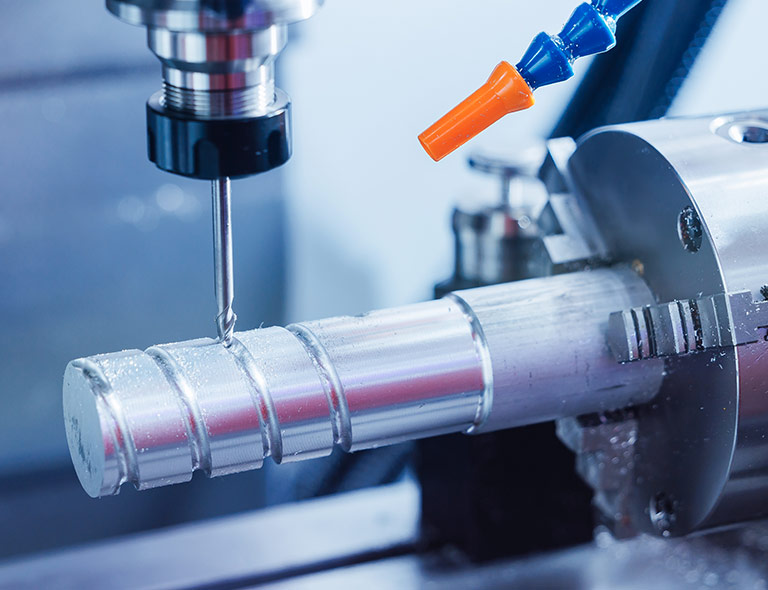
Machining on semi-finished products fixed on a rotary table involves a different approach: the workpiece is clamped and the tool and machine axes move.This configuration allows you to perform multiple operations in a single setup:
- turning;
- milling;
- drilling;
- multi-sided machining.
Process stability and dimensional control
While the rotary table offers a natural advantage in terms of workpiece rigidity, bar turning requires a higher level of know-how to achieve the same result in terms of size.At Guerrini Lauro we face these challenges on a daily basis thanks to:
- an advanced CNC machine park;
- structured control processes;
- highly specialized operators in bar processing;
- ability to maintain tight tolerances even on continuous production.
Guerrini Lauro: our fleet of machines
Our turning department integrates solutions dedicated to both bar machining with and without loader, and rotary table machining, allowing us to choose the most suitable technology without compromise.This operational flexibility represents a concrete value for customers who are looking for suppliers capable of not only governing complex processes.
The difference is not only in the technology, but in the ability to manage it. CNC bar machining requires expertise, control, and deep knowledge of the behavior of the material in rotation.
This is where Guerrini Lauro makes the difference: transforming a technical criticality into a production strength.
GUERRINI LAURO S.R.L.
Via Umberto I°, 65
Calcio - Bergamo - Italy
Tel. +39 0363 969646
VAT Number 03675810166
Paid-up share capital € 12.000,00
Privacy policy | Cookie policy

Via Umberto I°, 65
Calcio - Bergamo - Italy
Tel. +39 0363 969646
VAT Number 03675810166
Paid-up share capital € 12.000,00
Privacy policy | Cookie policy
 Design by It's Web Agency Brescia